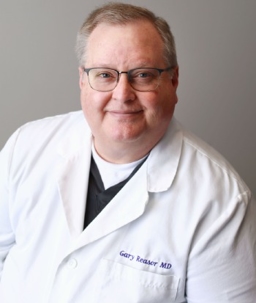
I encourage people to get out of themselves a bit. When you are hurting, it is easy to become wrapped up in your own problems. Helping someone else can take the focus off your pain and give you perspective.
– Dr. Gary Reasor
Dr. Gary Reasor approaches every patient visit with a simple guiding principle: they're the one in pain – it's the physician's job to listen and understand what they are going through. This approach led him to build an exceptional pain management practice in Louisville, Metro Pain Associates, that recently joined the Commonwealth network.
Get to know one of Commonwealth's newest and most experienced doctors in the interview below. Learn what motivates him, what the innovations in pain management he believes are making a real difference, and how he likes to unwind after a day at the clinic (it might surprise you).
What first drew you into pain management?
I didn’t start out to be a pain medicine specialist. During my residency I had originally planned on sticking with anesthesiology, but medicine had other plans. During my last year of residency, we were required to complete two six-month specialty tracks. I spent six months in cardiothoracic anesthesia and realized that if I never did another heart case again, I would be perfectly fine. The other six months were in pain management, and I saw real potential there.
In my first job out of residency with Hamilton Anesthesia Associates in Hamilton, Ohio, no one in the town was doing pain management. I talked with the senior partners, and they agreed we should start doing some low-level pain management. So, we started offering epidurals one day a week in recovery back in 1992. By 1994, I was practicing pain management full-time and eventually sought board certification. I kind of stumbled into it, but it turned out to be the right fit.
Are there any emerging treatments you are excited about?
Yes. The Intracept™ procedure, which uses radiofrequency ablation of the basivertebral nerve, has been a major advancement in the treatment of chronic vertebrogenic low back pain. The MILD procedure has also helped many people with lumbar spinal stenosis who are not candidates for full decompression and fusion.
In the long term, I think the future may lie in treating pain at the molecular or genetic level. If we can understand the genetic factors behind certain pain conditions, we may eventually be able to treat them much more precisely.
What daily habits do you encourage your patients to try?
First, stop smoking. Smoking and chronic pain often go together. Beyond that, I encourage people to get out of themselves a bit. When you are hurting, it is easy to become wrapped up in your own problems. Helping someone else can take the focus off your pain and give you perspective.
My wife and I ran a 12-step program for our church for a while. We used to say that if everyone piled their problems up like shoes and was told to pick a pair, most people would take their own problems back. At least you know how to deal with the ones that are yours. It is a good reminder that everyone is dealing with something.
When you think about your career, what makes you the proudest?
We have hit some home runs over the past 30-plus years. A lot of what we do is ongoing management, but some moments really stay with you. This is especially true with terminal cancer patients. I used to make house calls for patients who could not get to the office. You would make sure they were comfortable, say your goodbyes, and know it was the last time you would see them.
Those are the things that stand out. Helping someone ease their pain as they move from this life to the next stays with you.
Have your patients taught you anything over the years?
Oh, absolutely. The biggest lesson is that the patient is the one with the issue, not me. That means you need patience, and you cannot rush through things.
They have also taught me gratitude. Sometimes people thank me deeply for something I thought was small. That keeps you grounded.
How do you stay motivated in such a demanding field?
I still enjoy what I do. When I get up in the morning, I feel like I get to go to work. Some people ask how I can stand talking to people in pain all day, but I think of the people I am helping.
If you reach a point where you cannot stand it one more day, that is when it is time to leave. You are not doing your patients any favors if you stay past that point. Fortunately, I am not there.
.2512161030032.jpeg)
Above: Dr. Reasor's wife and granddaughter on Kiawah Island
What might surprise patients who only know you as their doctor?
I am a ham radio operator, which surprises people. I go home, get on the radio, and talk with people all over the world. It helps me unwind, even if it drives my wife crazy when I disappear into the ham shack for hours.
Before medicine, I completed an electrical apprenticeship. If I had gotten my journeyman's license, I probably would have retired a millionaire by now, but I went into medicine instead.
After a long clinic day, how do you recharge?
I go home and finish up any prescriptions I need to complete. Then I study scriptures. I am a member of the Church of Jesus Christ of Latter-day Saints, so I read from the Book of Mormon and other texts. After that, I study foreign languages. I served a mission in Peru, so I keep up my Spanish, and my French sister-in-law pushes me to improve my French.
After that, I get on the radio, and lately I have been learning Morse code. It is a foreign language of its own, and it helps me unwind.
What message or mindset do you try to share with every patient?
I think we learn from our experiences, even the difficult ones. Life is not always fair, and everyone faces challenges, but things can improve over time. We grow a great deal along the way.


.2509020933514.jpg)
